
Companies rent iPhones for trade shows because buying a fleet of devices for a one-time or occasional event rarely makes financial sense, and renting solves the logistics problem too, since equipment shows up ready to use and doesn’t need to be managed after the show ends. For a business that runs a handful of trade shows a year, purchasing 20 or 30 iPhones outright ties up capital in devices that sit unused for most of the year, depreciate immediately, and eventually need to be replaced, resold, or written off.
This decision comes up constantly for marketing teams, event managers, and sales leaders prepping for a trade show, conference, or expo booth. The short version: unless your company needs the same devices for daily, ongoing operations, renting almost always wins. Here’s the full breakdown of why.
The Real Cost Difference Between Renting and Buying
Buying iPhones for a trade show involves more than the sticker price. There’s the upfront purchase cost, setup and configuration time, data plans or SIM provisioning, insurance or loss protection, and eventual resale or disposal once the devices are outdated or no longer needed.
Renting iPhones for a trade show collapses all of that into a single line item. The devices arrive configured, get returned when the show ends, and the cost is scoped to exactly the days they were used.
| Cost Factor | Buying iPhones | Renting iPhones |
|---|---|---|
| Upfront cost | Full retail price per device | Rental rate for the event period only |
| Setup/configuration | Internal IT time required | Devices arrive ready to use |
| Data plans | New lines or SIMs to provision | Often bundled into the rental |
| Idle time between events | Devices sit unused, still depreciating | No cost when not renting |
| End-of-life | Resell, store, or dispose of devices | Devices returned, no disposal needed |
| Insurance/loss risk | Company owns the risk long-term | Typically covered under rental terms |
Trade Shows Are Short-Term, Buying Is a Long-Term Commitment
A trade show booth runs for a few days. A purchased iPhone is a multi-year asset. That mismatch is the core problem with buying devices for event use: you’re making a long-term financial commitment to solve a short-term operational need.
This becomes especially clear for companies attending multiple trade shows across the year, but not using the same devices for anything else in between. Those iPhones sit in a drawer, still losing resale value, until the next show months later.
Renting Solves the Configuration Problem Too
Trade show iPhones usually need to be set up a specific way, loaded with a lead capture app, locked down to prevent staff from using them for personal browsing, and provisioned with a data plan that works at the show’s location. Doing this in-house for a batch of purchased devices takes real IT time before the event and cleanup time after.
When companies rent iPhones for a trade show, this setup work is typically handled as part of the rental, and the devices are simply ready to hand out to booth staff on day one. That’s often a bigger time-saver than the cost difference alone.
When Buying Might Actually Make Sense
Buying isn’t always the wrong call. It tends to make more sense when:
- The company attends trade shows every month and the devices would otherwise be idle for less than a few weeks at a time
- The devices are also used for daily internal operations, not just events
- There’s an internal IT team already set up to manage device provisioning, security, and lifecycle at scale
For most companies attending a handful of shows a year, none of these conditions apply, which is exactly why renting has become the more common choice.
What to Look for When Renting iPhones for a Trade Show
Not every rental option is set up the same way. Before booking, it’s worth confirming:
- What model and storage capacity the devices come with
- Whether data plans and lead capture app setup are included
- How many devices are needed for your booth size and staff count
- What happens if a device is lost or damaged during the show
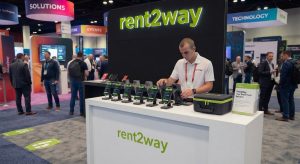
Rent2way supplies late-model iPhones for trade shows and corporate events nationwide, with flexible rental terms depending on your order and event details. Whether your event is at a major convention center or a smaller regional venue, Rent2way works with event and marketing teams to get the right number of rental iPhones ready before doors open.
FAQ
Is it cheaper to rent or buy iPhones for a trade show?
For most companies attending occasional trade shows, renting is cheaper overall once setup time, data plans, and post-event depreciation are factored in, not just the upfront device cost.
Do rented iPhones come with data plans for trade shows?
This depends on the rental provider and package. Contact Rent2way to confirm what’s included for your specific event and location.
How many iPhones do I need for a trade show booth?
This depends on booth size and staff count, but a common starting point is one device per staff member handling lead capture or check-in, plus a spare or two for backup.
Can rental iPhones be set up with our lead capture app before the event?
Setup requirements vary by event and app. Reach out to Rent2way’s team ahead of your trade show to discuss configuration needs.
What happens if a rented iPhone is lost or damaged at the show?
Terms for lost or damaged equipment are outlined in the rental agreement. Contact Rent2way to review specifics before your event.
Can I rent iPhones for trade shows in any city?
Rent2way provides iPhone rentals nationwide, wherever your event is located, with rental terms confirmed based on your event’s specific details.
