
Two-Way Radios, Hotspots, and Phones: Choosing the Right Mix for Your Event
Event teams that rely solely on personal smartphones or a single device type lose coordination the moment attendance hits several thousand. Local cell towers saturate, call setup times climb, and group messaging collapses under bandwidth contention. The reliable solution is a deliberate hybrid of three technologies, each assigned to the operational role it performs best.
Quick Takeaways
- Assign conventional UHF/digital two-way radios to every safety, medical, and operations role that requires sub-second, one-to-many voice.
- Deploy dedicated 4G/5G wireless hotspots exclusively for POS terminals, ticket scanners, production Wi-Fi, and any data-heavy workstation that must stay offline from the public network.
- Limit cellular handsets (iPhones or managed smartphones) to private one-on-one executive coordination, vendor escalation, and external calls.
- Never treat consumer phones or PTT apps on personal devices as the primary channel once attendance exceeds roughly 5,000 in a confined venue.
- Source a single pre-programmed kit—radios, multi-carrier hotspots, and managed phones—so channel plans, charging, and delivery are synchronized.
Executive Answer
Radios deliver sub-second teamwide safety and logistics voice over local RF independent of cell towers. Dedicated hotspots isolate POS, ticket scanners, and production Wi-Fi from public congestion. Cell phones handle private 1-on-1 executive communication and vendor escalation. The optimal mix assigns each technology to its precise operational role and eliminates single-point failure from tower saturation.
Core Technology Breakdown: Radios vs. Cellular Handsets vs. Wireless Hotspots
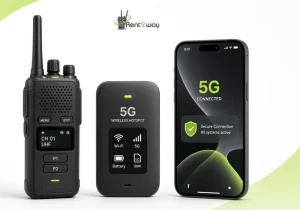
Two-way radios (Motorola CP200, Turbo XPR digital series, Hytera PD/TC series, and 4G LTE PTT models) operate on licensed or fleet-covered UHF frequencies. Voice travels via direct RF or a local repeater with near-zero call-setup latency. Group channels open instantly; one press reaches every radio on the channel. UHF provides better building penetration than VHF in convention halls and arenas. Battery life typically exceeds a full shift when paired with multi-unit bank chargers. IP-rated commercial housings withstand dust, rain, and drops. These units require no cellular infrastructure and remain functional when public networks fail.
Cellular handsets (iPhones and managed smartphones) excel at private, addressed calls and data applications that demand a full operating system. They support email, vendor apps, and external escalation. Latency includes standard cellular call-setup delay and is subject to the same tower congestion that affects every other attendee device. They are the correct tool for one-to-one executive traffic and off-site coordination, not for rapid team broadcasts.
Wireless hotspots (Verizon and AT&T 5G models) create private Wi-Fi islands. They supply dedicated throughput for point-of-sale systems, barcode or RFID scanners, production laptops, and temporary office networks without competing for the same macro-cell resources used by the crowd. Properly placed units maintain connectivity inside large halls when public Wi-Fi or attendee phones collapse under load. They do not replace voice radios; they protect data-critical workflows.
The tower-congestion trap is straightforward physics and capacity planning. Macro cells serving a venue have finite resource blocks. When 5,000–50,000 phones simultaneously attach, register, and attempt data or voice sessions, uplink and downlink resources are exhausted. Call setup times lengthen, packets drop, and PTT apps that rely on the same network become unusable. Local RF two-way radios and dedicated hotspot SIMs operating on carrier enterprise or private slices avoid that contention.
Comparison Matrix
| Device | Latency / Call-Setup | Range / Coverage | Group Calling Speed | Battery / Shift Life | Best Operational Role |
| Two-way radios (UHF/digital / LTE PTT) | Sub-second RF; near-zero setup | Local RF + optional repeater; building penetration via UHF | Instant one-to-many | Full shift with bank chargers | Safety, medical, operations, production floor |
| Cellular handsets (iPhone / managed phone) | Standard cellular setup lag | Nationwide where towers allow; subject to congestion | One-to-one only | Variable; requires mid-shift charging | Executive, VIP, vendor escalation |
| Wireless hotspots (4G/5G) | Data throughput dependent on carrier | Local Wi-Fi island; multi-carrier SIMs improve reliability | N/A (data only) | Extended with external power or swap | POS, ticketing, production Wi-Fi, scanners |
Hardware Deployment Matrix by Event Role
| Event Role | Primary Device | Secondary / Backup Device | Rationale |
| Security / Safety Marshals | Two-way radio (dedicated channel) | Radio + earpiece; limited phone for external LE | Instant group alerts; no tower dependency |
| Medical / First Aid | Two-way radio (medical channel) | Radio + discreet earpiece | Sub-second dispatch; privacy via earpiece |
| Operations / Logistics | Two-way radio (ops channel) | Radio + speaker mic | Continuous coordination across zones |
| Ticketing / Box Office | Dedicated 5G hotspot + scanner tablets | Hotspot + managed phone for escalation | Isolated data path; avoids public Wi-Fi failure |
| VIP Concierge | Cellular handset | Phone + secondary radio if moving into radio zones | Private conversations and external calls |
| Production Leads | Two-way radio (production channel) | Radio + hotspot for show-control data | Voice for cues; private data for media servers |
| Event Director / Executive | Cellular handset | Phone + radio for all-call capability | 1-on-1 privacy with ability to join radio nets |
The Hybrid Deployment Model: Department-by-Department
Security, medical, and floor operations live on radios. Pre-program distinct channels or talkgroups so traffic stays segregated. Equip each radio with surveillance earpieces or speaker mics according to noise environment and hands-free needs. Multi-unit bank chargers keep the fleet topped up between shifts.
Ticketing, concessions, and any cashless or scanning station receive their own hotspot. Place units high and clear of metal structures. Use multi-carrier SIMs where available so the system can fail over if one network degrades. Keep these devices completely separate from the public attendee Wi-Fi.
VIP, talent, and senior production staff carry managed cellular handsets for private conversations and external vendor or agency calls. These phones do not replace radios for team-wide alerts; they supplement them.
A practical 3-step decision flow balances cost against mission-critical redundancy:
- Map every role to its latency and addressing requirement (group instantaneous vs. private delayed).
- Calculate the minimum radio count that covers all safety and operations positions, then add 10–15 % spares.
- Layer hotspots only where data isolation is required and cellular handsets only where one-to-one privacy or external reach is required. Source the entire package from one provider so programming, labeling, charging, and delivery arrive as a single, tested kit at least 24 hours before load-in.
Rent2way supplies exactly this integrated package: commercial two-way radios (including Motorola, Hytera, and 4G LTE PTT models), multi-carrier 5G hotspots, late-model iPhones and tablets, surveillance earpieces, speaker microphones, and multi-unit bank chargers. Radios ship pre-programmed to your channel plan, batteries arrive fully charged, FCC licensing is covered under the fleet authorization, and delivery is scheduled to arrive at least one day prior to the event. Zero maintenance liability remains with the renter; the equipment is returned with pre-paid labels after the show.
Frequently Asked Questions
Why not just use an app like Zello on personal phones?
Personal phones and PTT apps share the same congested macro towers as the attendees. Once capacity is exhausted, latency spikes and group calls fail. Dedicated radios operate on independent RF and remain available regardless of cellular load.
Do hotspots work inside convention center halls?
Yes, when multi-carrier 5G units are placed with clear line-of-sight to outdoor signal or near windows and elevated positions. They create a private Wi-Fi island that does not compete with the public network for the same resources.
How do rental radios handle multi-channel coordination?
Radios are pre-programmed with distinct channels or digital talkgroups for security, medical, operations, and production. Users switch channels as needed; the programming is completed before shipment so on-site setup is limited to power-on and channel selection.
Can one provider supply radios, hotspots, and phones as a single kit?
Yes. A unified rental eliminates mismatched arrival times, inconsistent programming, and separate support contacts. Pre-labeled channel plans, fully charged batteries, bank chargers, and nationwide delivery coordinated to the event schedule are standard.
For festivals, trade shows, conferences, and large corporate events, the hybrid model radios for instantaneous team voice, dedicated hotspots for isolated data, and cellular handsets for private escalation removes the single points of failure that pure smartphone deployments introduce. Request an itemized quote with the exact mix of two-way radios, wireless hotspots, cellular handsets, and accessories required for your venue and attendance.
